
VentPlus for schools
A classroom is the most densely occupied room in almost any building. Forty children in a room built for thirty, windows shut against noise, dust and the afternoon heat — CO2 from their own breathing climbs past 2,000 ppm before the second period is over. The symptoms look exactly like boredom: drooping attention, yawning, restlessness, a teacher losing the room.
The VentPlus CO2 monitor & controller measures the air continuously and switches the classroom's existing exhaust or fresh-air fan on the moment CO2 crosses the level you set — then switches it off again when the air is clean. Nobody has to remember. Nothing has to be rewired.
A 40-student classroom · 45 sq m · windows and door closed
Every 1 litre-per-second-per-person increase in classroom ventilation was associated with a rise in the proportion of students passing standardised maths and reading tests — measured across 100 elementary-school classrooms in the United States. Ventilation is not a comfort issue in a school. It is an academic one. Source: Haverinen-Shaughnessy et al., Indoor Air (2011)
The VentPlus solution
VentPlus plugs into an ordinary 230V socket. Your classroom's exhaust fan plugs into the AC socket on the unit. Set the Fan ON level (1,500 ppm is a sensible classroom default) and the Fan OFF level (900 ppm) with four front-panel keys, and the room manages itself from then on. There is a 3-position Auto / Off / On switch if a teacher ever wants to override it by hand.
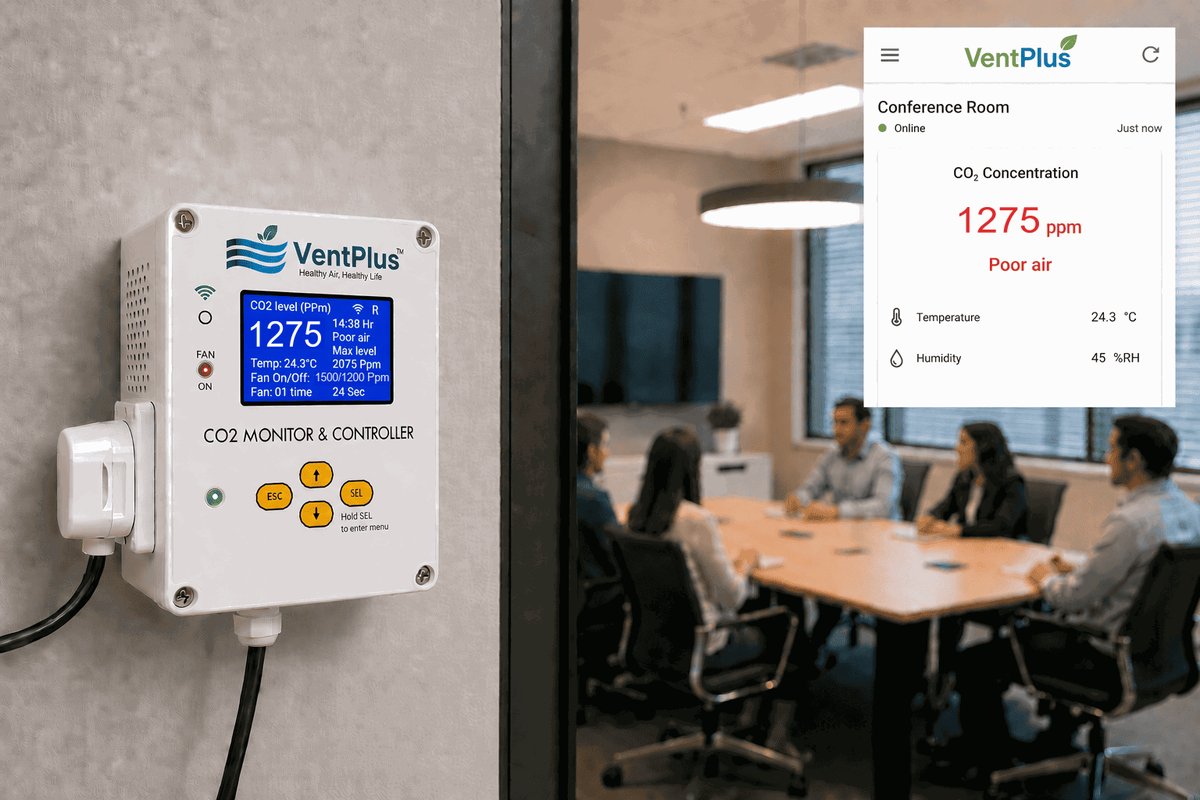
An industrial NDIR sensor reads the actual CO2 in the room, 24×7 — not a proxy, not an estimate.
Fresh air starts the moment your threshold is crossed, mid-lesson, without anyone getting up.
Once the room is clear the fan switches off, so you are not pumping hot outdoor air or dust into the room all afternoon, or paying to run fans in an empty building.
Every unit uploads its readings to the VentPlus dashboard, so a principal or facilities head can see all monitored classrooms from one screen and check which rooms actually get stuffy — useful evidence when planning where to spend on ventilation. Temperature and relative humidity are graphed alongside CO2, so you can also see which classrooms overheat in summer, and the Excel download includes all three for every reading.
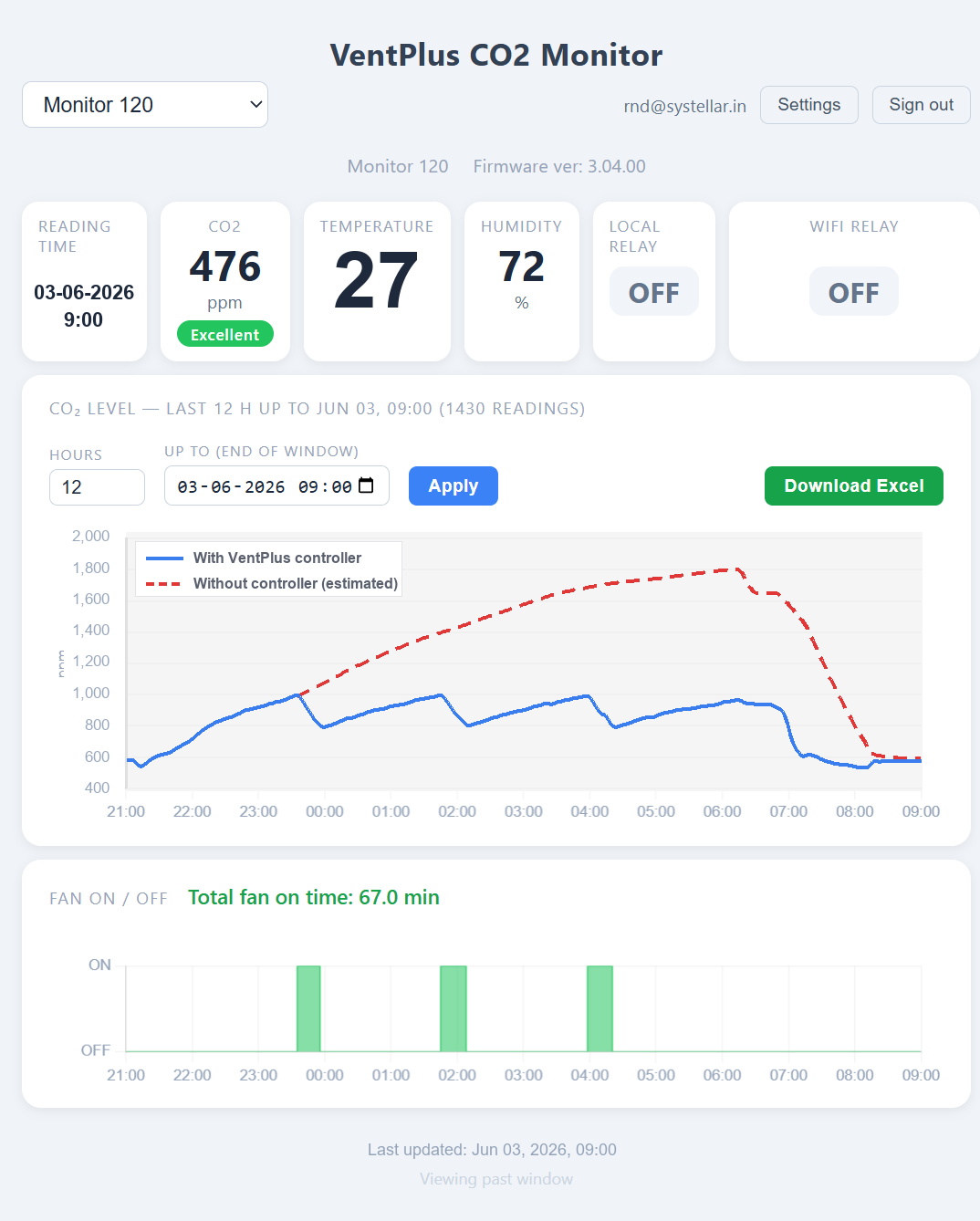
VentPlus remote monitoring website — same interface works on mobile, tablet and desktop
Want to try it yourself? Open a live VentPlus dashboard right now — no login, no signup, straight into a real device's data: live readings, plus CO2, fan, temperature and humidity graphs you can download to Excel.
Open a Live Monitoring Dashboard →Tap Open a Live Monitoring Dashboard and give it about 2 seconds to log in and load the live demo.
Classroom air quality is one of the better-studied areas in indoor air science, because schools are easy to measure and the outcome — test performance — is already recorded. The findings are consistent.
In a controlled classroom experiment, raising the outdoor-air supply rate improved the speed at which children performed schoolwork tasks, with error rates unchanged — more work done, no loss of accuracy.
Wargocki & Wyon 2007, Indoor AirAcross 162 California classrooms, higher ventilation rates were associated with measurably lower illness absence. Ventilation dilutes airborne pathogens as well as CO2 — and CO2 is the practical way to know whether it is happening.
Mendell et al. 2013, Indoor AirASHRAE Standard 62.1 and WHO guidance both put well-ventilated indoor air at roughly 600–1,000 ppm. Above 1,500 ppm a room is under-ventilated by any standard. VentPlus holds the band for you.
ASHRAE 62.1 · WHO indoor air guidanceBetter air, better attention, better results.
Common questions
Tell us how many classrooms, their approximate size and what fans you already have, and we will tell you exactly what you need — and what it will cost. Bulk pricing is available for multi-room orders.
or call +91 99170 80700
Downloads
Get the full VentPlus CO2 monitor & controller documentation — everything you need to evaluate, buy and install.