
VentPlus for healthcare
An OPD waiting area, a diagnostic centre reception, a dialysis floor, an IVF lab — these are rooms where people sit shoulder to shoulder for hours, often in a building where the ventilation was designed for a much smaller crowd. CO2 is the fastest, cheapest, most continuous way to know whether that ventilation is actually working right now.
VentPlus measures CO2, temperature and humidity continuously, switches ventilation on when the room needs it, and logs every reading to a dashboard you can download to Excel. It is a control device and a record at the same time.
An OPD waiting area · 30 seats · morning session
CO2 does not measure infection risk directly, and VentPlus is not a medical device. What CO2 does measure is how much of the air in the room has already been through someone else's lungs — which is why public-health guidance during and after COVID-19 settled on CO2 monitoring as the practical way to check that shared indoor spaces are being ventilated.
The VentPlus solution
Manual spot-checks with a handheld meter tell you about one minute of one day. VentPlus reads the room continuously, acts on what it reads by driving the exhaust or fresh-air fan, and keeps the history. When an accreditation body, an infection-control committee or a hospital board asks how the ventilation in a given area performs, the answer is a chart rather than an opinion.
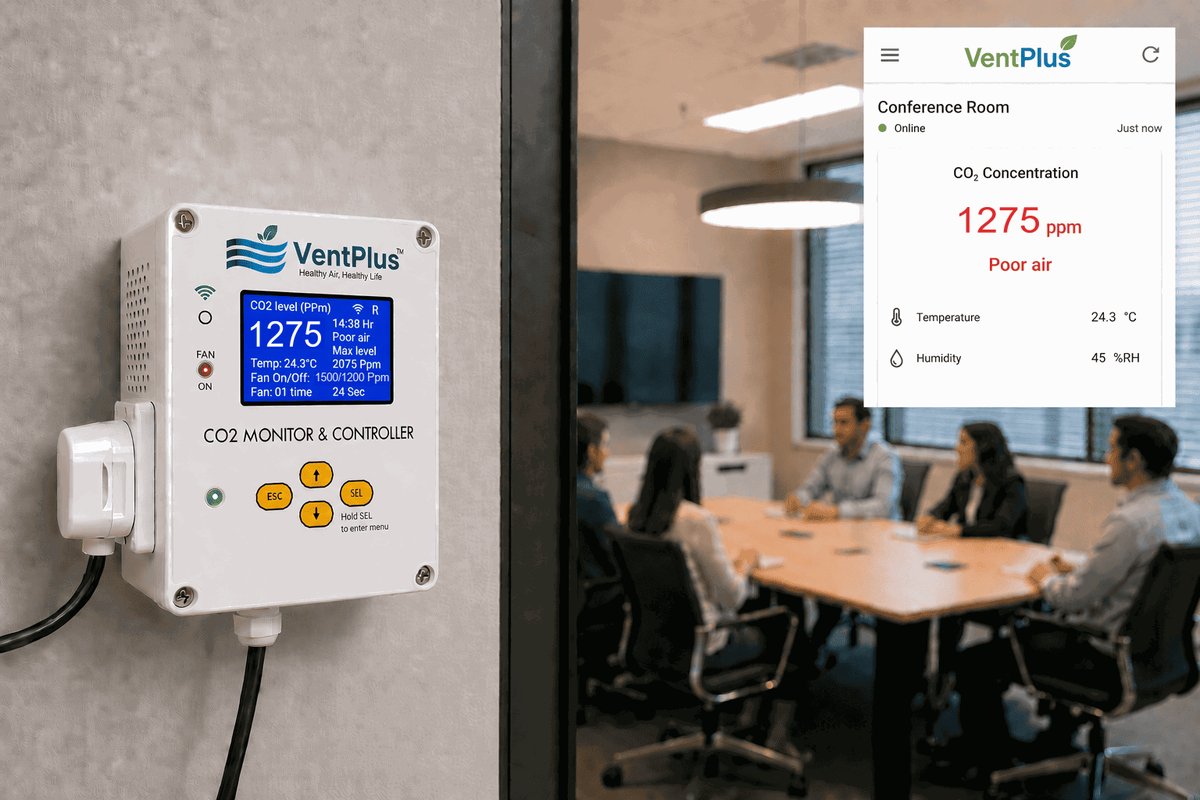
Waiting halls, OPD corridors, reception, day-care rooms, staff rooms, canteens — the crowded non-clinical spaces where CO₂ climbs highest and monitoring is usually thinnest.
The relay drives the existing exhaust or fresh-air fan the moment your threshold is crossed. A 3-position Auto/Off/On switch gives staff a manual override when they need one.
Every reading uploads over Wi-Fi. Historic CO₂, temperature and humidity export to Excel for audits, reports and infection-control review.
A facilities engineer can watch every monitored area from one browser — which floors go stale in the afternoon, whether the new AHU setting actually changed anything, whether the fan on the second floor is running at all. The record is continuous, so a problem shows up as a trend rather than as a complaint. CO2, temperature and relative humidity each have their own graph over the same window, and the Excel download gives all three, reading by reading, for audits and infection-control review.
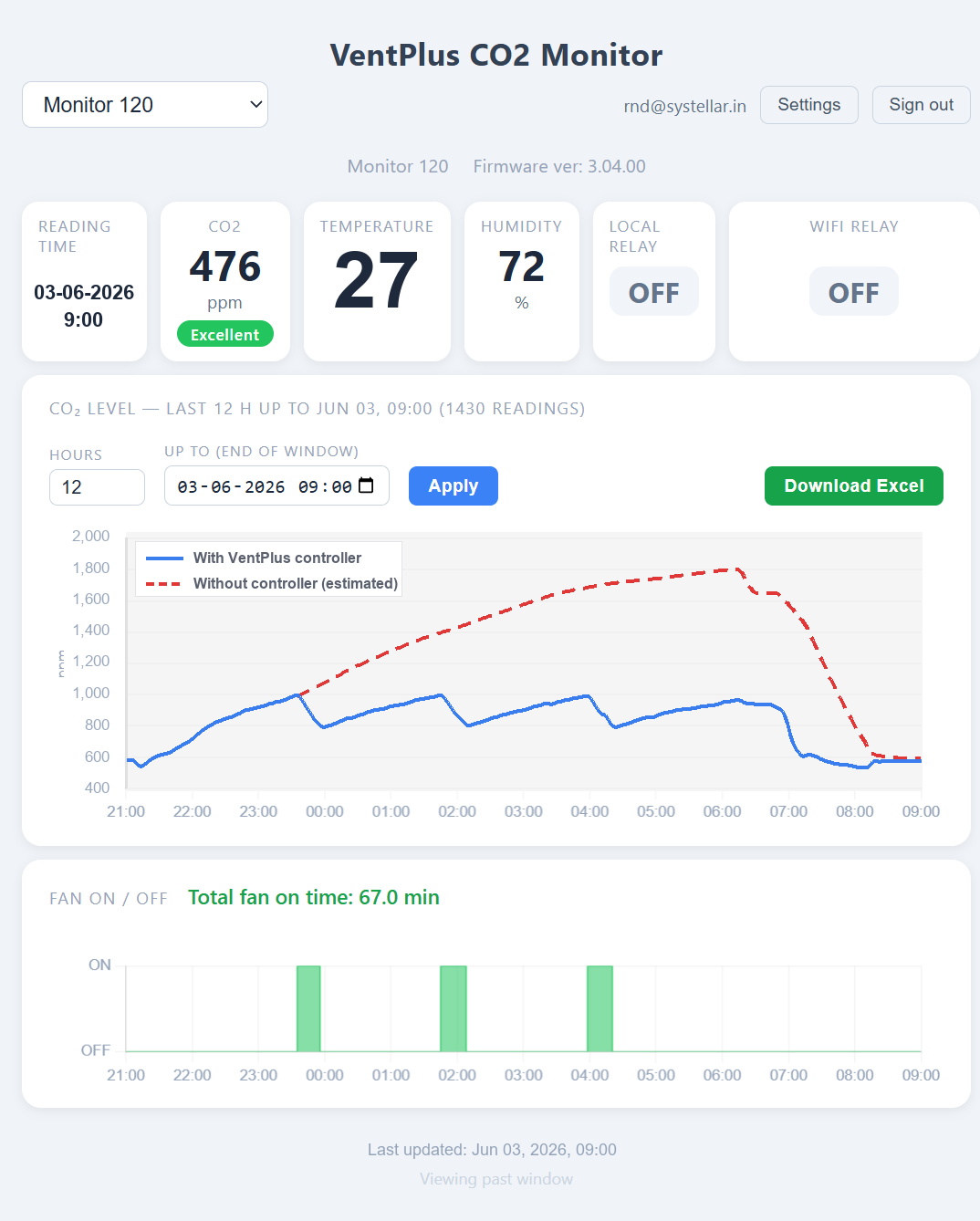
VentPlus remote monitoring website — same interface works on mobile, tablet and desktop
Want to try it yourself? Open a live VentPlus dashboard right now — no login, no signup, straight into a real device's data: live readings, plus CO2, fan, temperature and humidity graphs you can download to Excel.
Open a Live Monitoring Dashboard →Tap Open a Live Monitoring Dashboard and give it about 2 seconds to log in and load the live demo.
Hospitals already ventilate their critical areas to standard. The gap is almost always in the ordinary rooms — waiting areas, corridors, staff rooms — where occupancy is high, design assumptions are old, and nobody is measuring.
ASHRAE Standard 62.1 sets minimum outdoor-air rates per person and per unit floor area. CO2 concentration is the practical, continuous check on whether a room is actually receiving them, and it is what demand-controlled ventilation systems act on.
ASHRAE Standard 62.1An industrial NDIR sensor, accurate to ±(50 ppm + 5% of reading) after a 10-minute warm-up, measuring across 400–5,000 ppm. NDIR measures carbon dioxide directly and stays stable for years, unlike the cheap chemical sensors used in consumer gadgets.
VentPlus Main Unit specificationThe fan you already have plugs into the socket on the unit. No BMS integration project, no new cabling, no contractor. If the fan is in another room, the optional Wi-Fi Relay bridges it over the internet.
Plug and playYou cannot manage ventilation you are not measuring.
Common questions
Tell us which areas concern you — waiting halls, OPD, staff rooms — with approximate sizes and occupancy, and we will recommend where to put the first units and what thresholds to set.
or call +91 99170 80700
Downloads
Get the full VentPlus CO2 monitor & controller documentation — everything you need to evaluate, buy and install.