
VentPlus for basements
In a room above ground, a badly ventilated day gets fixed the moment somebody opens a window. A basement has no such fallback. Whatever the fan delivers is the entire air supply, and if the fan is off — or on a timer set five years ago by someone who has left — the room simply accumulates.
Basement offices, society gyms, storerooms, server rooms, lower-ground restaurants and staff areas all sit in this category. VentPlus measures the CO2 in the room and runs the ventilation fan on demand: hard when the room is occupied, off when it is empty.
A basement office · 80 sq m · fan on a fixed timer
A basement fan is almost always in one of two wrong states: off, because it is noisy and costs money and nobody has complained loudly enough; or on continuously, because that felt safer, which means it runs all night through an empty room. Demand-controlled ventilation replaces both with a fan that responds to the actual CO2 in the room.
The VentPlus solution
Basement ventilation is nearly always installed and nearly always uncontrolled — a switch on a wall, or a timer. VentPlus puts the fan under the control of the one measurement that reflects whether the room actually needs air. The fan plugs into the socket on the unit; larger fans run through a contactor. Nothing gets rewired, and there is an Auto/Off/On switch for manual control.
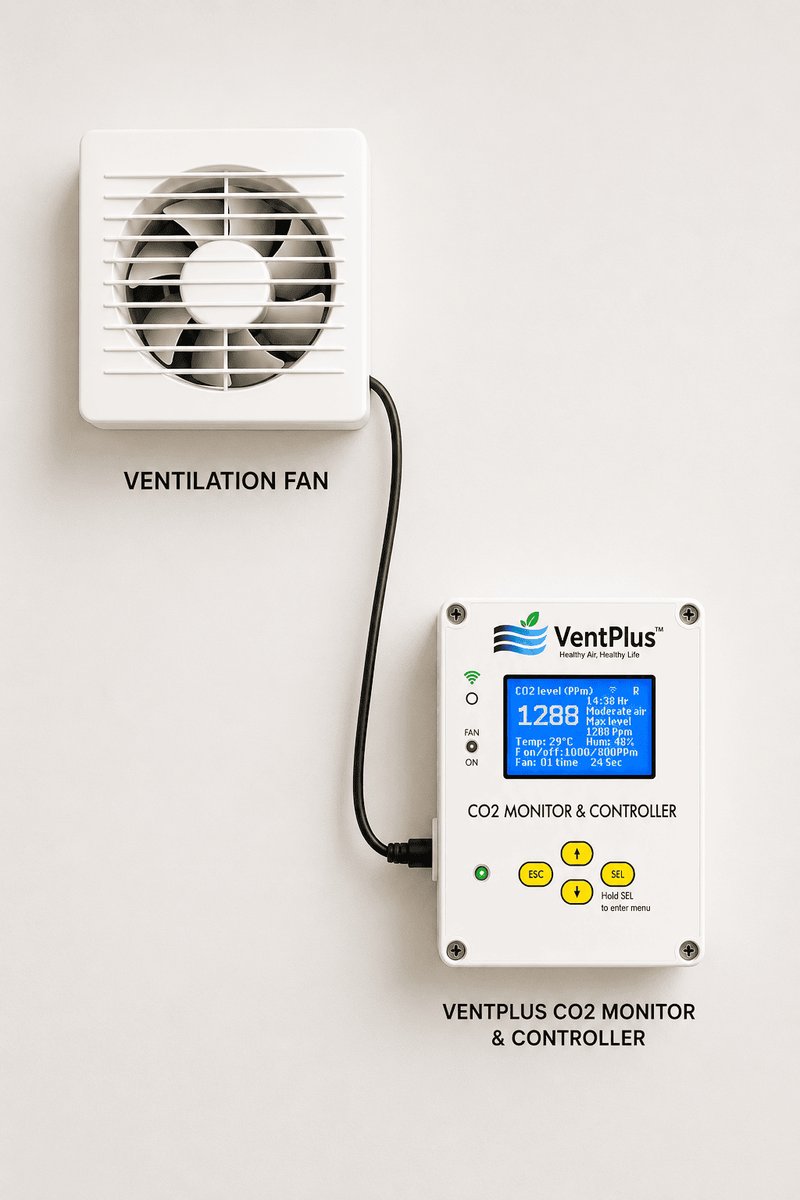
Mount the unit where people actually are — the desk area, the gym floor, the counter — not next to the fan or the inlet, where the reading will always look good.
1,500 ppm ON and 900 ppm OFF suits most occupied basements. The fan then tracks occupancy without anybody managing it.
Between 9 p.m. and 8 a.m. an empty basement generates no CO₂, so the fan stays off. That is where demand-controlled ventilation pays for itself.
The history answers the question that basement occupants can never answer for themselves: is the fan actually working? A flat line at 500 ppm means yes. A daily climb to 2,000 ppm means the fan is undersized, blocked, or off — and now you have the evidence to take to the building manager. Temperature and relative humidity graphs sit alongside, so the same screen shows whether the basement is also running damp.
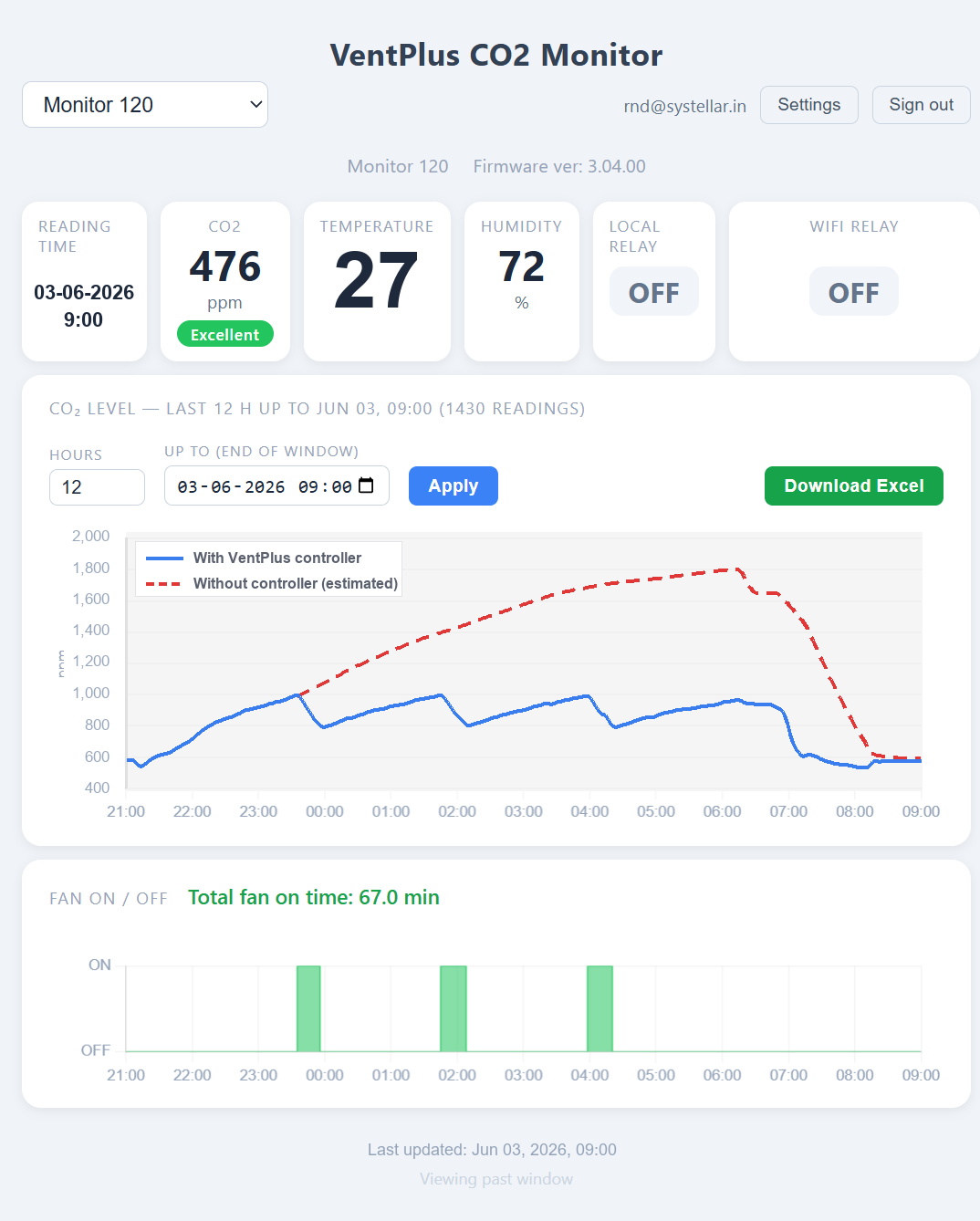
VentPlus remote monitoring website — same interface works on mobile, tablet and desktop
Want to try it yourself? Open a live VentPlus dashboard right now — no login, no signup, straight into a real device's data: live readings, plus CO2, fan, temperature and humidity graphs you can download to Excel.
Open a Live Monitoring Dashboard →Tap Open a Live Monitoring Dashboard and give it about 2 seconds to log in and load the live demo.
Basements are the clearest case for demand-controlled ventilation, because the alternative is not natural ventilation — the alternative is nothing.
Cognitive-function scores fall about 21% for every 400 ppm rise in indoor CO2. A basement office that runs at 1,800–2,500 ppm all afternoon is paying that cost every day.
Allen et al. 2016, Environ. Health Perspect.Harvard researchers found doubling office ventilation raised cognitive scores by 8%, at under $40 per person per year in energy. The same mechanism works in reverse in an under-ventilated basement.
MacNaughton et al. 2015, Int. J. Environ. Res. Public HealthVentPlus measures carbon dioxide, temperature and humidity. It does not measure carbon monoxide. A parking garage with running vehicles requires a dedicated CO detection system to code — VentPlus complements that in the occupied rooms off the parking area, it does not replace it.
Stated plainly, on purposeIf the fan is the only air supply, something should be watching it.
Common questions
Tell us the room size, how many people use it, and what fan is installed. We will tell you what to set and whether one unit is enough.
or call +91 99170 80700
Downloads
Get the full VentPlus CO2 monitor & controller documentation — everything you need to evaluate, buy and install.