
VentPlus for poultry & livestock
For the first week, the shed has to be warm. So the fans come down, the inlets close, and the brooders run — and brooders are gas burners that produce CO2 of their own, on top of what the birds and the litter produce. Every farmer knows the shed gets close during brooding. Very few know the actual number.
The number matters, because published broiler management guidance puts the CO2 ceiling at around 3,000 ppm at chick level, and sheds routinely pass it in the first week. VentPlus reads the CO2 where the chicks are and switches the minimum-ventilation fan on when it crosses your setting — so you get the heat you need without silently losing early performance.
CO₂ at chick level · brooding week · minimum ventilation
Broiler management guidance from the major breeding companies converges on a CO2 ceiling of about 3,000 ppm measured at chick level, with 2,500 ppm preferred. High brooding CO2 is associated with poorer early growth and higher incidence of ascites. The reason it goes unmanaged is simply that nobody is measuring it — the shed feels warm, which is the thing the farmer is optimising for.
The VentPlus solution
Most sheds run minimum ventilation on a timer: so many seconds in so many minutes, set at the start of the cycle and adjusted by feel. A timer does not know that last night was colder, that the litter is wetter, or that the brooders ran longer. CO2 knows all three, because it is the direct product of all of them. VentPlus turns the fan on when the CO2 says the shed needs it and off when it does not.
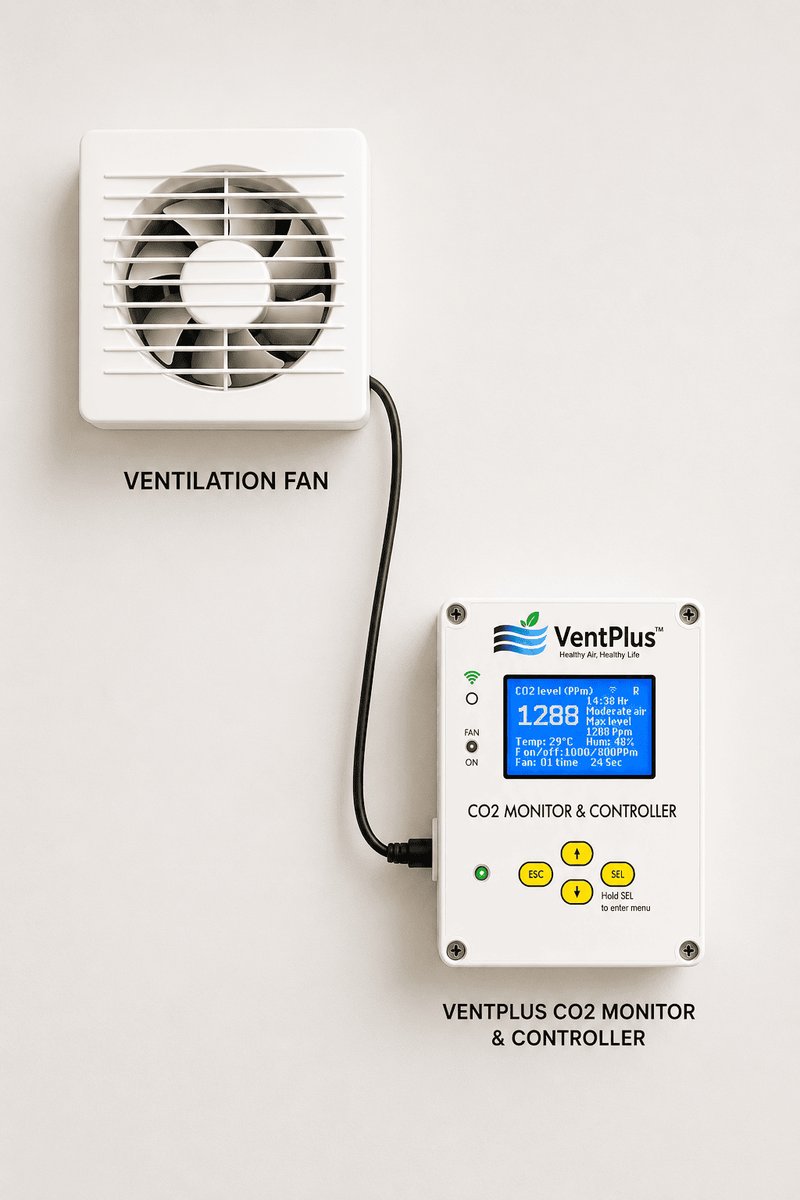
Mount the unit where the birds actually are. The reading that matters during brooding is the one at the floor, not the one at the walkway.
3,000 ppm ON and 1,600 ppm OFF is a conservative brooding-week setting. Both are changed from the front panel in seconds as the birds grow and ventilation increases.
Readings upload over Wi-Fi. On a cold night you can check whether the shed is holding its band from your phone, and see the whole night's curve in the morning.
The overnight curve is the useful one. It shows whether minimum ventilation actually held the shed through the coldest hours, or whether CO₂ ran up between fan cycles and came back down only when the day warmed. That is the single most actionable chart in a brooding week, and it downloads to Excel alongside temperature and humidity. Both also have their own graphs on the dashboard, over the same time window as CO2 and fan run-time.
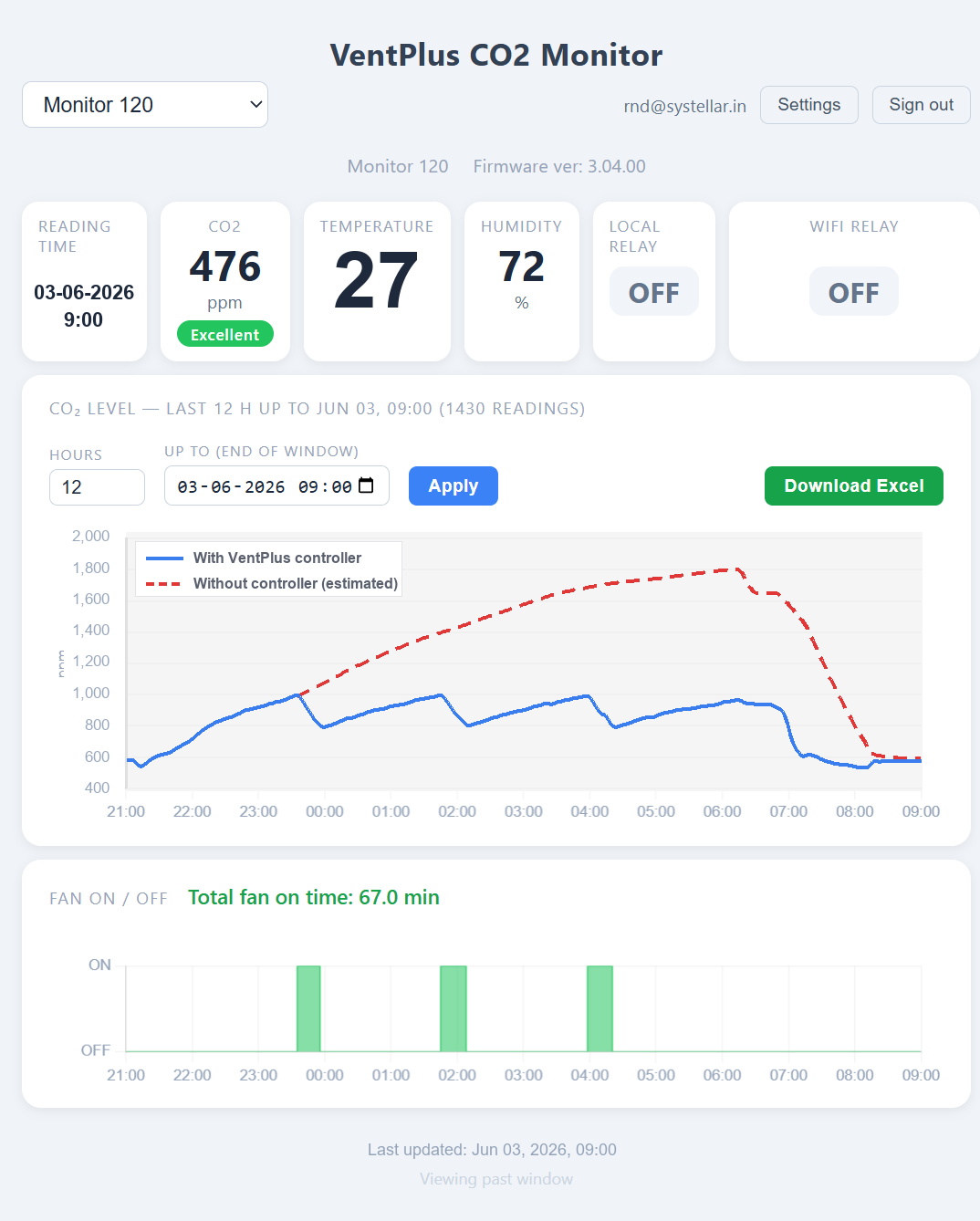
VentPlus remote monitoring website — same interface works on mobile, tablet and desktop
Want to try it yourself? Open a live VentPlus dashboard right now — no login, no signup, straight into a real device's data: live readings, plus CO2, fan, temperature and humidity graphs you can download to Excel.
Open a Live Monitoring Dashboard →Tap Open a Live Monitoring Dashboard and give it about 2 seconds to log in and load the live demo.
Temperature tells you whether the birds are warm. Ammonia tells you about the litter. CO₂ is the one measurement that tells you directly whether the shed is getting enough fresh air — because it is produced by the birds, the litter and the brooders together.
Broiler management guides from the major breeders converge on approximately 3,000 ppm CO2 maximum at chick level, with 2,500 ppm preferred. Above it, early growth suffers and ascites incidence rises.
Broiler management guidanceThe VentPlus measuring range covers the entire band a poultry shed operates in, from ambient to well past any acceptable ceiling. Accuracy is ±(50 ppm + 5% of reading) from an industrial NDIR sensor after a 10-minute warm-up.
VentPlus Main Unit specificationThe unit is rated to 95% relative humidity and 0–50°C — which a shed floor during brooding will genuinely test. The Auto/Off/On switch lets a stockman override it by hand at any time.
VentPlus Main Unit specificationWarm and stale is a trade. Measure what it cost you.
Common questions
Tell us your shed dimensions, bird numbers, brooding setup and existing fans. We will recommend where to mount the unit and what thresholds to start the cycle with.
or call +91 99170 80700
Downloads
Get the full VentPlus CO2 monitor & controller documentation — everything you need to evaluate, buy and install.