VentPlus for cold chain

A sealed room
is a room that fills up

Cold storage is built to be airtight, because air leakage is wasted refrigeration. The consequence is that anything producing CO2 inside the room has nowhere to send it. Stored fruit and vegetables respire and give off CO2 for their entire storage life. Dry ice sublimates. CO2-based refrigeration (R744) leaks. And CO2 is heavier than air, so it pools at floor level, exactly where someone walks in.

VentPlus monitors CO2 continuously across 400–5,000 ppm, sounds its beeper at a level you set, and switches the room's exhaust fan on automatically — so the room is already ventilating before anyone opens the door.

ISO 9001:2015 Certified Manufacturer Designed & Made in India 1-Year Warranty
R
CO2 Monitor
2100
ppm CO2
Temp
25
°C
Humidity
58
% RH
GOOD
RELAY 1
OFF
Wi-Fi Relay
OFF
Set levels on this unit Fan On: 3,000 ppm Fan Off: 1,000 ppm

Occupational exposure reference points for carbon dioxide

400ppm Outdoor Ambient air. What an empty, ventilated room returns to.
1,000ppm Good Comfort ceiling for occupied indoor space.
2,000ppm Moderate A clear sign the room is not exchanging air.
3,000ppm Poor A sensible alarm and fan-trigger setting for a walk-in room.
5,000ppm Occupational limit The 8-hour occupational exposure limit (ACGIH TLV-TWA / OSHA PEL). Top of the VentPlus measuring range.
30,000ppm Short-term limit ACGIH 15-minute STEL. Beyond what any general-purpose ventilation controller should be relied on for.
5,000 ppm

The occupational exposure limit for carbon dioxide is 5,000 ppm averaged over an 8-hour shift (ACGIH TLV-TWA, matching the OSHA PEL), with a 15-minute short-term limit of 30,000 ppm. The VentPlus measuring range runs to 5,000 ppm, which covers the whole warning band up to the shift limit — it is a monitoring and ventilation device, not a confined-space entry instrument.

400–5,000 ppm VentPlus measuring range — covers the full warning band
Heavier than air CO2 pools at floor level in a still, sealed room
24×7 Continuous monitoring, logged and downloadable

The VentPlus solution

Monitor the room continuously,
and ventilate it before anyone walks in

A handheld meter tells you about the moment you were standing there with it. A sealed room needs something that watches it all the time. VentPlus reads CO2, temperature and humidity continuously, triggers its beeper at your alarm level, and drives the exhaust fan through its relay so the room clears itself. Because the readings upload over Wi-Fi, a supervisor can check a room from outside it — which is the right place to check a sealed room from.
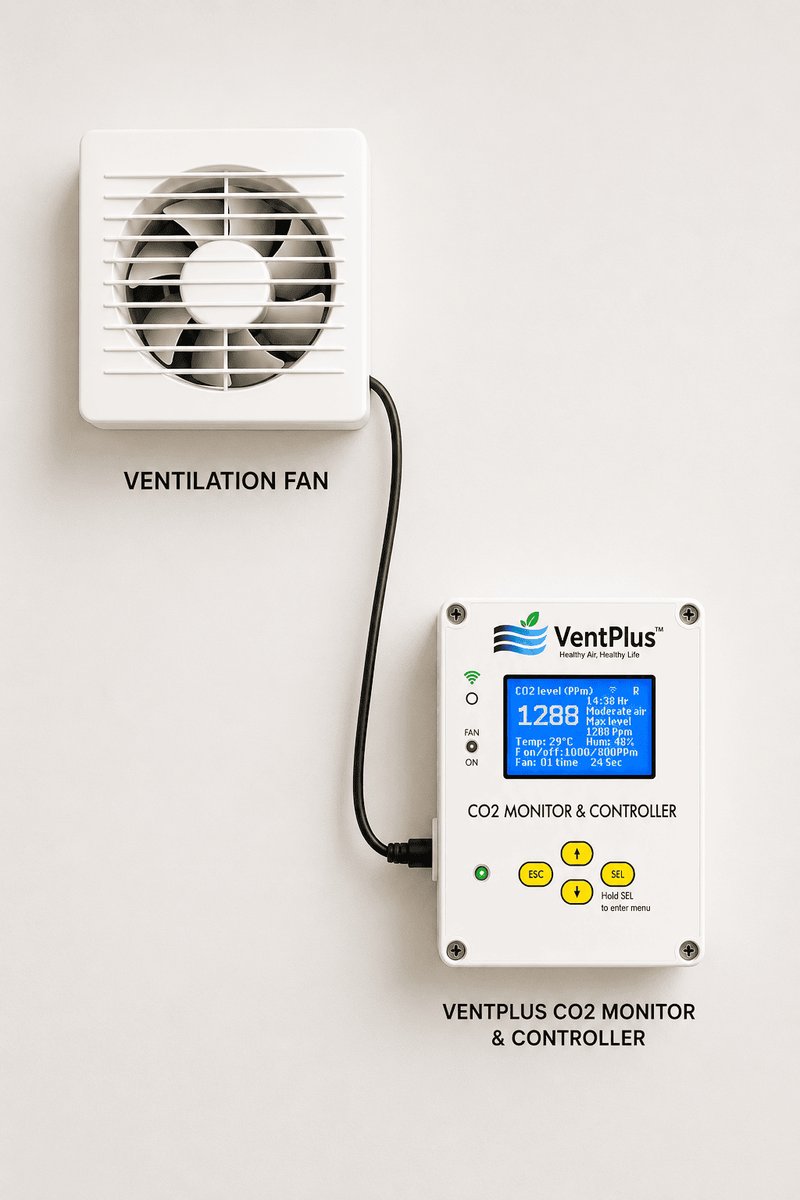
VentPlus CO₂ monitor and controller wired to a ventilation fan serving a cold storage room
VentPlus driving an exhaust fan — the standard cold-room installation
1

Continuous CO₂, temperature and humidity

Rated for high-humidity environments to 95% RH — cold rooms are wet, and most electronics are not specified for it.

2

Alarm before entry, not after

Set the beeper level and the fan trigger to suit the room. The exhaust runs automatically, so the air is already being replaced before the door opens.

3

Check it from outside the room

The dashboard shows live and historic CO₂ for every monitored room from any browser. Data exports to Excel for HSE records.

Real-Time and Historical CO2, Temperature
and Humidity Monitoring From Anywhere

For a cold-chain operator the value is the history: which rooms drift up over a storage cycle, whether a fan is actually running, what happened overnight. Every reading uploads over Wi-Fi and the whole series downloads to Excel for safety records and audits. Temperature and relative humidity are graphed next to CO2 and included in the same Excel file, within the unit's 0–50 °C range.
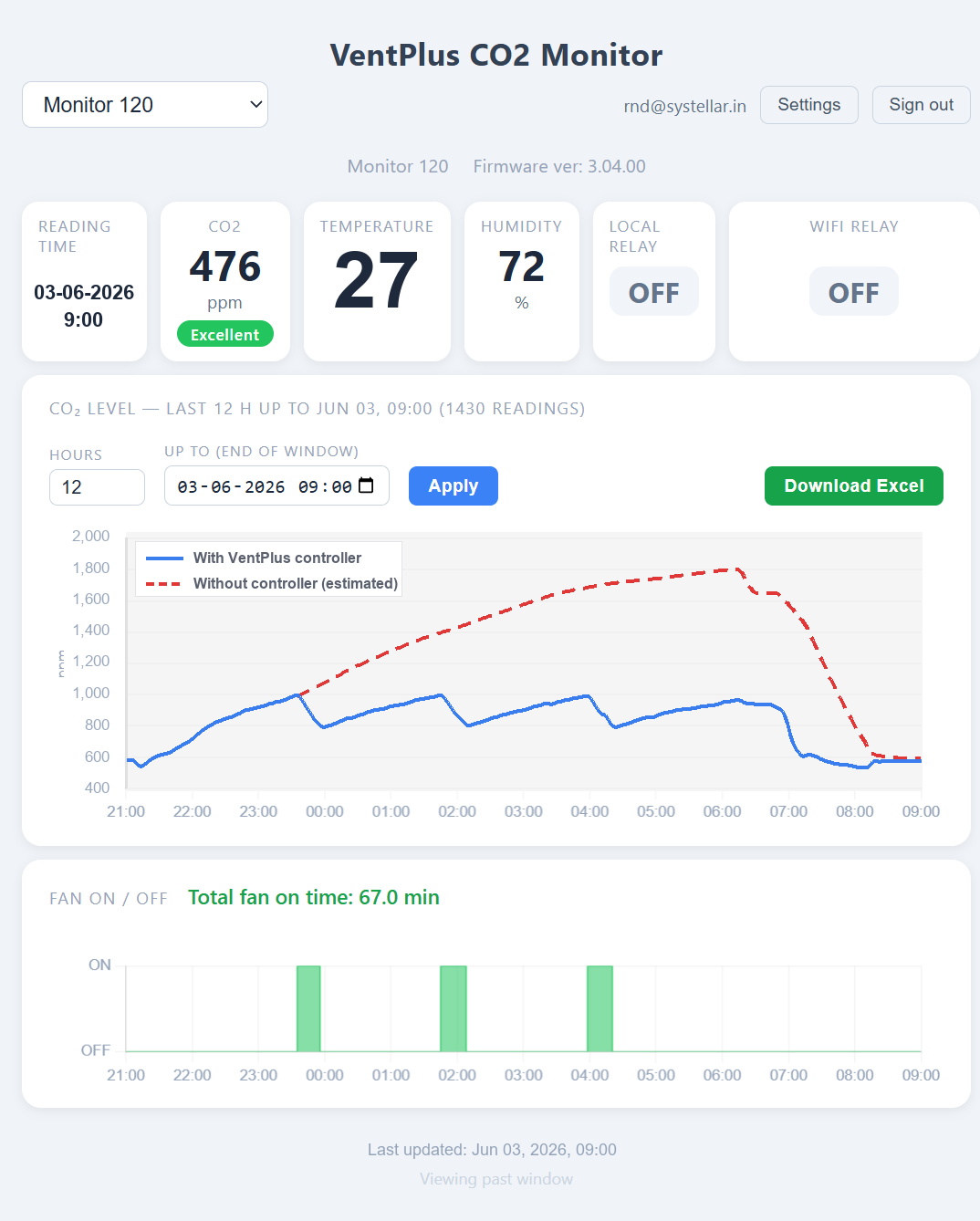
monitor.ventplus.in — VentPlus CO2 Monitor
VentPlus remote dashboard showing CO₂ held below the healthy threshold with the controller versus climbing to unhealthy levels without it

VentPlus remote monitoring website — same interface works on mobile, tablet and desktop

Want to try it yourself? Open a live VentPlus dashboard right now — no login, no signup, straight into a real device's data: live readings, plus CO2, fan, temperature and humidity graphs you can download to Excel.

Open a Live Monitoring Dashboard →

Tap Open a Live Monitoring Dashboard and give it about 2 seconds to log in and load the live demo.

Where the CO₂ in a cold room comes from

It is worth being precise about the sources, because they behave differently — and only one of them stops on its own.

Produce
Respiration

Harvested fruit and vegetables keep respiring in storage, consuming oxygen and releasing CO2 for their entire storage life. In a well-sealed room with a large load, that alone lifts CO2 steadily — which is the whole basis of controlled-atmosphere storage.

Post-harvest physiology
Dry ice
Sublimation

One kilogram of dry ice releases roughly 0.5 m³ of CO2 gas as it sublimates. In a sealed cold room or a refrigerated vehicle, a routine quantity of dry ice can raise the concentration far above the occupational limit with no warning smell or colour.

Physical property of solid CO₂
R744
Refrigerant leaks

CO2 is increasingly used as a refrigerant (R744) in modern low-GWP systems. A leak in a plant room or a machinery space is invisible and odourless, and CO2 is denser than air, so it accumulates low down.

Refrigeration practice
Cold rooms Ripening chambers Warehouses Food processing units Dairy plants Refrigerated transport docks Plant rooms Fermentation & brewing areas

A room you cannot smell a problem in is a room that has to be measured.

Common questions

CO₂ in cold storage — questions we get

The occupational exposure limit is 5,000 ppm averaged over an 8-hour shift (ACGIH TLV-TWA, matching the OSHA PEL), with a 15-minute short-term limit of 30,000 ppm. Above roughly 3,000 ppm most people begin to notice breathing discomfort and headache. A practical approach is to alarm and ventilate well before the limit — many operators set the VentPlus fan trigger at 2,000–3,000 ppm.
It covers the entire warning band up to the 8-hour occupational limit, which is what a monitoring-and-ventilation device needs to do: tell you the room is heading the wrong way and start clearing it. It is not a confined-space entry instrument and should not be used as one — a controlled-atmosphere store deliberately held at 3% CO2 (30,000 ppm), or a CO2 plant room requiring a life-safety alarm to EN 378 / ISO 5149, needs a purpose-built high-range gas detector. We would rather tell you that than sell you the wrong device.
Carbon dioxide is about 1.5 times denser than air. In a still, sealed, unventilated room it stratifies, with the highest concentration at low level. That matters for where you mount a sensor and it matters for anyone working at floor level — which is why a room should be ventilating before someone enters it, not after.
The unit is rated for 0–95% RH and measures temperature across 0–50°C, so the electronics are specified for damp environments. The sensor itself is an industrial NDIR type, which does not drift the way cheap chemical sensors do. Mount it out of direct water spray and away from the evaporator discharge.
Yes — and in cold storage that is the normal case. The optional Wi-Fi Relay Unit puts the switched socket wherever the exhaust fan is while the sensor stays inside the room, communicating over the internet rather than a shared Wi-Fi network.
It detects carbon dioxide, so it will register a leak of a CO2-based refrigerant (R744) as a rising CO2 concentration. It does not detect ammonia, hydrocarbons or fluorinated refrigerants — those need their own gas-specific detectors, and a refrigeration machinery room generally requires a certified life-safety detection system regardless.

Talk to us about your cold rooms

Tell us the room volume, what is stored, whether dry ice or CO₂ refrigerant is involved, and what exhaust equipment exists. We will tell you honestly whether VentPlus is the right device for the room — and where it is not.

See product models and specs Get in touch

or call +91 99170 80700

Downloads

Product brochure & user manual

Get the full VentPlus CO2 monitor & controller documentation — everything you need to evaluate, buy and install.