
VentPlus for indoor growers
This is the part that surprises people. In a room full of plants under strong light, photosynthesis pulls CO2 out of the air faster than a sealed room can replace it. Within an hour of lights-on, a tight grow room can fall below the 420 ppm outside — and at that point the light you are paying for is no longer the limiting factor. The CO2 is.
Enrichment is the standard answer, and at adequate light levels it is well established that raising CO2 to roughly 1,000–1,500 ppm increases growth substantially. But enrichment only pays if the level is actually held — and holding it is a control problem, not a bottle problem. That is what VentPlus does.
CO₂ in an indoor growing space · lights on
The commonly used enrichment band for indoor growing under adequate light. Enrichment above ambient increases photosynthetic rate in C3 plants — but only while light, water and nutrients are not themselves limiting. Enriching a dim room does nothing, and enriching a leaky room does nothing for long. The control is the product, not the gas.
The VentPlus solution
An indoor grower has two problems that pull in opposite directions. Lights-on depletes CO2 and you need to add it. Lights-off, with no photosynthesis, CO2 accumulates from the plants' own respiration and from anything else in the room, and you need to vent it. VentPlus handles both from one measurement: it switches your CO2 source when the level falls below the band, and it switches the exhaust fan when the level rises above it.
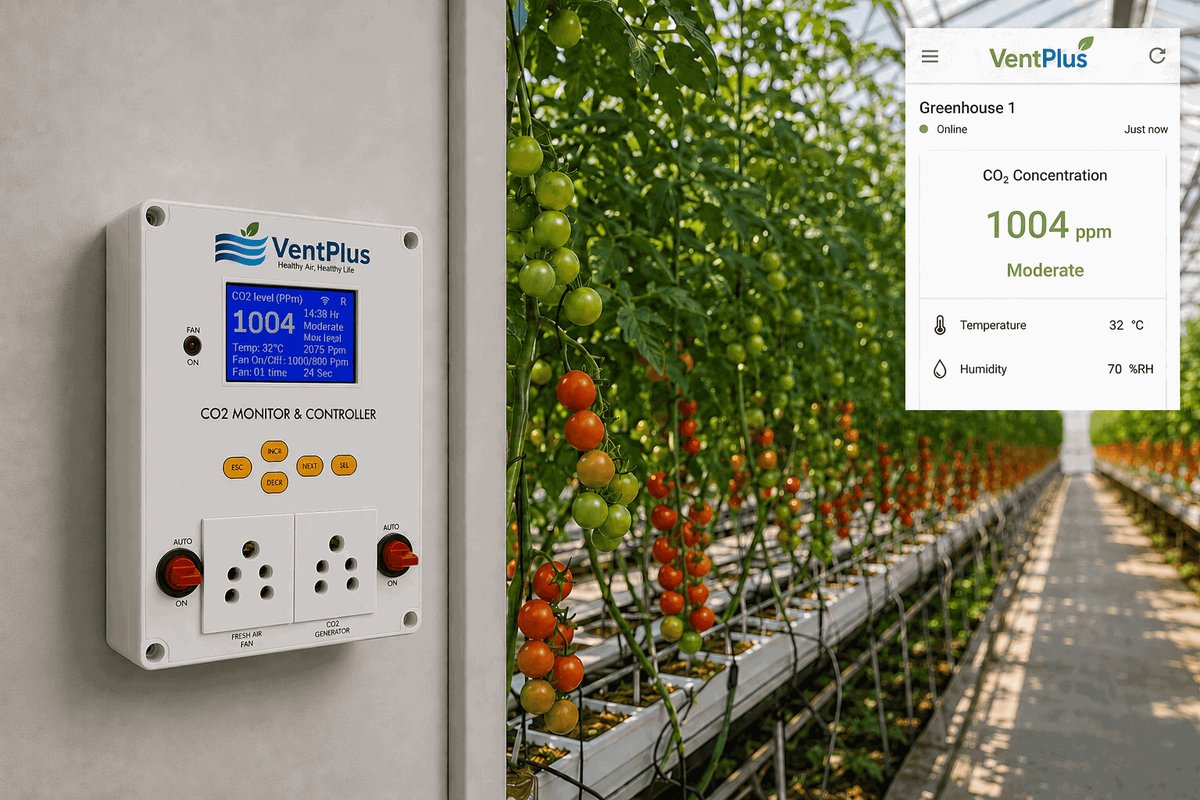
Give the controller a lower level (the CO₂ source comes on below it) and an upper level (the fan comes on above it). The room then holds the band regardless of how the day goes.
A door left open, a bigger canopy, a hotter afternoon — all change the CO₂ balance, and all are handled automatically because the controller is reacting to the measurement rather than to a timer.
Live and historic CO₂, temperature and humidity on the dashboard. The overnight curve tells you whether your room is really sealed and whether the enrichment is genuinely holding.
For a grower the historic chart is the whole argument. It shows whether the room actually held 1,200 ppm through the photoperiod or spent four hours at 500 because the regulator was undersized — a difference you cannot see, smell or infer from the plants until weeks later. Temperature and relative humidity are graphed over the same window, so a CO2 dip can be checked against lights-on heat and humidity, and all three download to Excel.
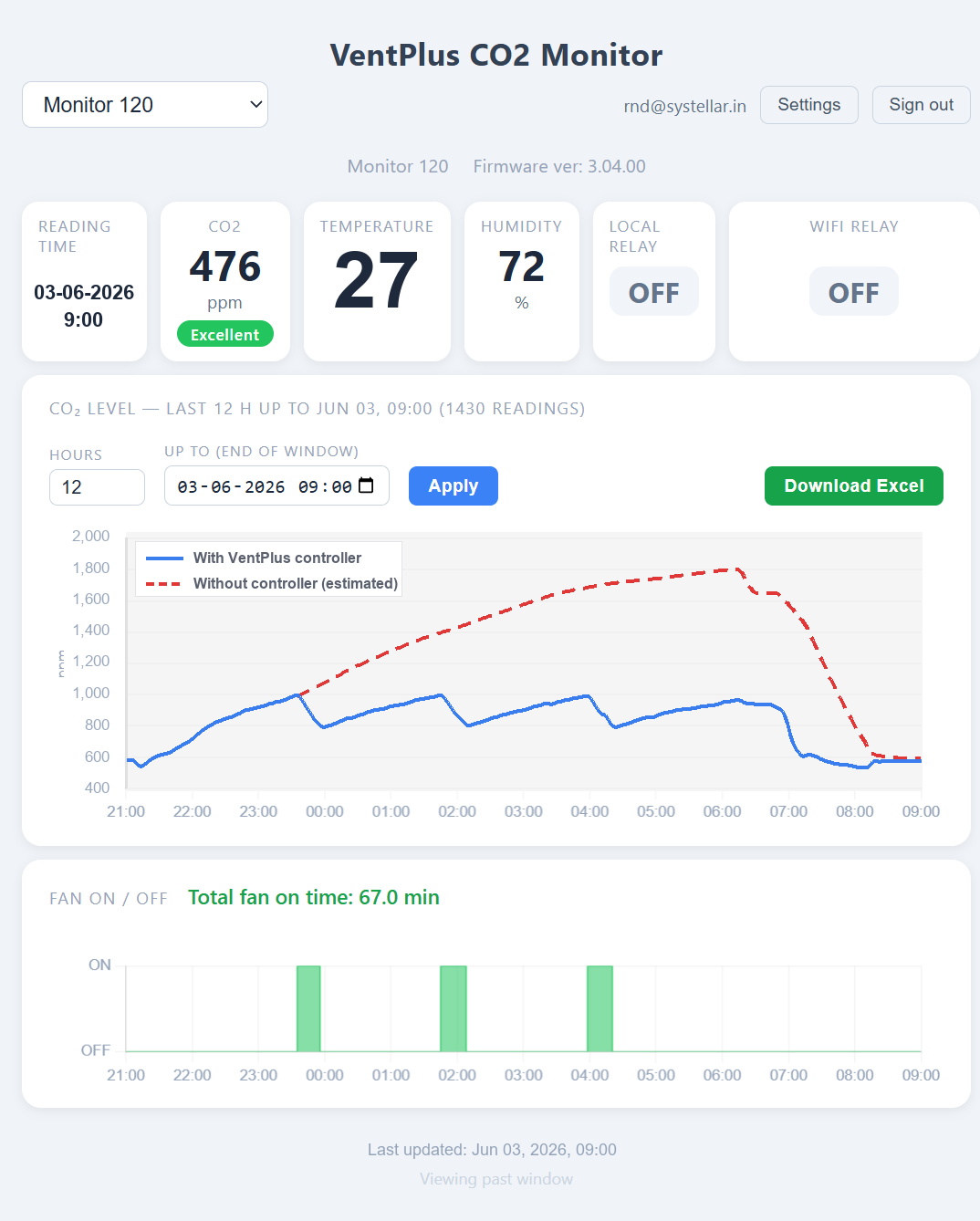
VentPlus remote monitoring website — same interface works on mobile, tablet and desktop
Want to try it yourself? Open a live VentPlus dashboard right now — no login, no signup, straight into a real device's data: live readings, plus CO2, fan, temperature and humidity graphs you can download to Excel.
Open a Live Monitoring Dashboard →Tap Open a Live Monitoring Dashboard and give it about 2 seconds to log in and load the live demo.
CO₂ enrichment is one of the best-established interventions in protected cultivation. It is also routinely oversold. Here is the honest version.
Enrichment increases photosynthetic rate in C3 species — most leafy greens, fruiting vegetables, herbs and ornamentals grown indoors. C4 species respond far less. The gain comes from suppressing photorespiration, and it is real, repeatable plant physiology.
See our full research summary on CO₂ and yieldEnrichment only helps while light is not the limiting factor. In a dim room, adding CO2 changes nothing, because the plant cannot use it. Fix light, water and nutrition first; enrich after. Anyone selling you CO2 as a fix for a light problem is selling you the wrong thing.
Liebig's law of the minimumThe 8-hour occupational exposure limit for CO2 is 5,000 ppm. Enrichment bands sit well below it, but a room with a CO2 source and a control failure does not. Always ventilate an enriched room before working in it, and never rely on smell — CO2 has none.
ACGIH TLV-TWA / OSHA PELEnrichment without control is an expense, not an investment.
Common questions
Tell us your room volume, light level, canopy size and what CO₂ source you use or plan to use. We will recommend the configuration and the thresholds to start from.
or call +91 99170 80700
Downloads
Get the full VentPlus CO2 monitor & controller documentation — everything you need to evaluate, buy and install.