
In short
- Buy NDIR. It measures CO2 directly. Cheap “air quality” monitors that show “eCO2” estimate it from other gases and are not usable for growing.
- Match the range to the stage you manage. Fruiting needs accuracy between about 500 and 1,500 ppm. Spawn run can sit at 5,000–20,000 ppm, above what most meters read.
- Check the humidity rating. A fruiting room runs at 85–95% RH. A meter rated for offices will drift or fail.
- Place it among the bags, at the height the mushrooms form — not by the door, the fan or the humidifier.
- A meter tells you. A controller acts. If you will read the number and then switch a fan by hand, you are the controller.
Every guide to mushroom growing says the same thing about CO2: high during spawn run, low during fruiting. What few of them say is that you cannot see, smell or feel the difference between 800 ppm and 2,500 ppm. The mushrooms can. By the time the stems are long and the caps are small, the reading you needed was a week ago.
So the first piece of equipment is a meter. Here is what separates one that helps from one that misleads.
1. The sensor: NDIR, nothing else
An NDIR (non-dispersive infrared) sensor shines infrared light through a small chamber of air and measures how much is absorbed at the wavelength CO2 absorbs. It is measuring CO2 itself.
Many low-cost “air quality monitors” use a different sensor, a metal-oxide (MOX) gas sensor, and display a number labelled eCO2 or “equivalent CO2”. That number is calculated from volatile organic compounds, on the assumption that the gases come from people. A mushroom room is full of other volatile compounds from the substrate and the mycelium, so the estimate has no reliable link to the real CO2. If the spec sheet does not say NDIR, assume it is not.
2. The range: which stage are you managing?
| Stage | Typical CO₂ | What the meter must do |
|---|---|---|
| Spawn run / colonisation | 5,000–20,000 ppm | Confirm the room is high. A reading of “above 5,000” is often enough information. |
| Pinning | Falling to ~1,000 ppm | Show the drop accurately, so you know when the trigger has happened. |
| Fruiting / cropping | Below 1,000–1,500 ppm | Hold a band. This is where accuracy decides quality. |
Most NDIR meters sold for rooms and offices read 400–5,000 ppm. That range covers pinning and fruiting completely, which is where most quality is lost. In spawn run the same meter will simply sit at its maximum. That is not a fault; it tells you the room is high, which is what spawn run wants. If you need to know how high — for example, to confirm a closed spawn-run room is not over-accumulating — you need an extended-range sensor.
Safety note: a room above 5,000 ppm is above the 8-hour occupational exposure limit, and one above 30,000 ppm is above the 15-minute limit. A meter that reads “over range” is telling you to ventilate before anyone works inside.
3. Humidity: the spec most people skip
Fruiting rooms are among the wettest environments any electronic device will face: 85–95% relative humidity, often with misting. Check the meter's rated humidity range, not just its CO2 range. A device rated to 80% RH is being used outside its specification in every fruiting room.
Mount it where water will not be sprayed or drip directly onto it, and away from the humidifier outlet, where the air is saturated and not representative of the room.
4. Accuracy, and how to check it yourself
A good NDIR sensor is typically specified at around ±(50 ppm + 5% of the reading). At 1,000 ppm that is ±100 ppm — tight enough to hold a fruiting band.
You can sanity-check any meter in five minutes: take it outdoors, away from traffic and people, let it settle, and read. Open outdoor air is around 420 ppm. A meter that reads 250 or 700 outdoors needs calibration before you trust it indoors. Do not breathe on it while you wait.
5. Display, log or control?
There are three kinds of device, and the difference matters more than any spec:
| Type | Good for | Limitation |
|---|---|---|
| Handheld NDIR meter | Spot checks across several rooms; finding dead corners. | Only knows the moment you are standing there. |
| Wall-mounted monitor with logging | Seeing the whole day and night: when the room climbs, how fast, and during which part of the flush. | Someone still has to switch the fan. |
| Monitor and controller | Holding the band automatically: the fan runs when CO2 rises past your ON threshold and stops at your OFF threshold. | Needs a fan that can actually move enough air (see sizing the exhaust fan). |
The load in a fruiting room is not constant: it rises as the flush develops and changes when the door is opened for harvest. A person reading a display twice a day will be right twice a day. That is the whole argument for a controller.
Where to put it

- Among the bags or beds, at the height where the fruit bodies form. That is the air the mushrooms are growing in.
- Not next to the door, which reads low every time it opens, and not next to the exhaust fan, which reads the air that is already leaving.
- Not in the humidifier plume or under a misting line.
- One per room. In a long house, measure both ends at least once during a flush. A large difference explains uneven flushes better than anything else.
A meter that also runs the fan
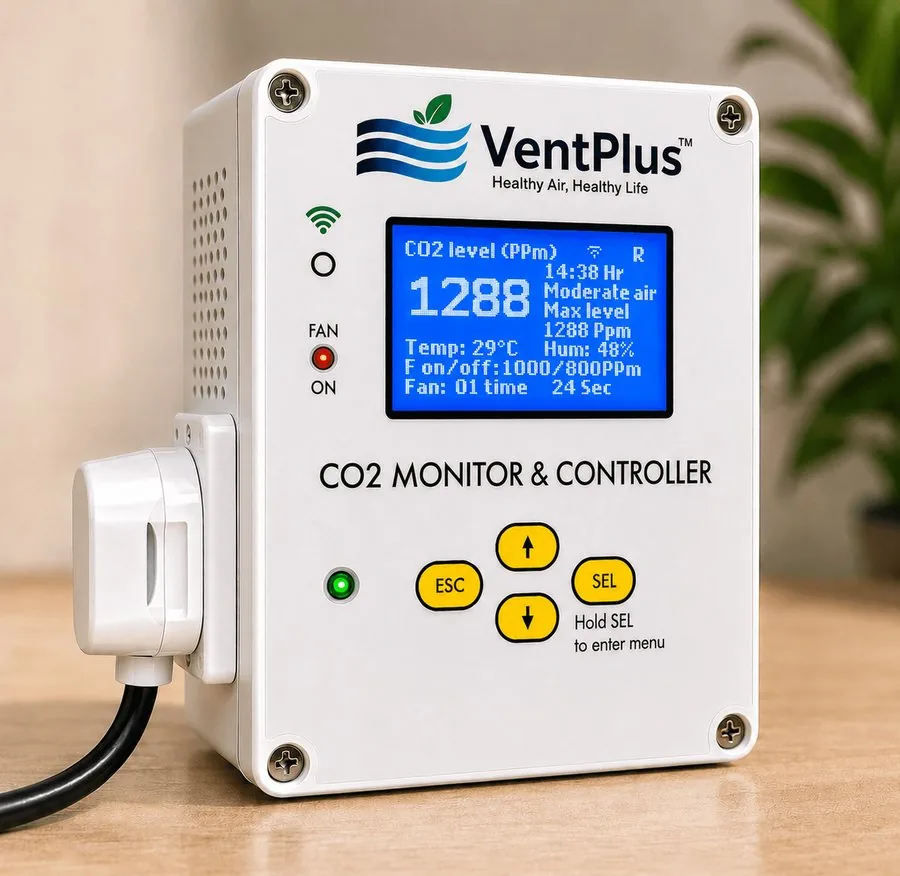
VentPlus uses an NDIR sensor (400–5,000 ppm, ±(50 ppm + 5% of reading)), also measures temperature and humidity, and is rated to 95% RH. It switches your exhaust fan at the thresholds you set, and logs the crop to a dashboard you can open in any browser and export to Excel. ₹8,499, made in India.
We are also developing a version that measures 400 – 10,000 ppm, for spawn-run rooms that sit above the standard 5,000 ppm range. It is not yet available. If you need it, call +91 99170 80700, WhatsApp us or send an enquiry.
See VentPlus for mushroom farmsThe short version
Buy an NDIR sensor rated for the humidity of a fruiting room, put it among the bags, and check it against outdoor air. If your problem is fruiting quality — long stems, small caps, uneven flushes — a standard 400–5,000 ppm range covers everything you need. And if you are going to act on the reading every time it rises, let the meter do the acting.
Sources
- Directorate of Mushroom Research (ICAR), Solan. dmr.icar.gov.in
- Stamets P., Growing Gourmet and Medicinal Mushrooms.
- ACGIH Threshold Limit Values for carbon dioxide: 5,000 ppm TWA, 30,000 ppm STEL.